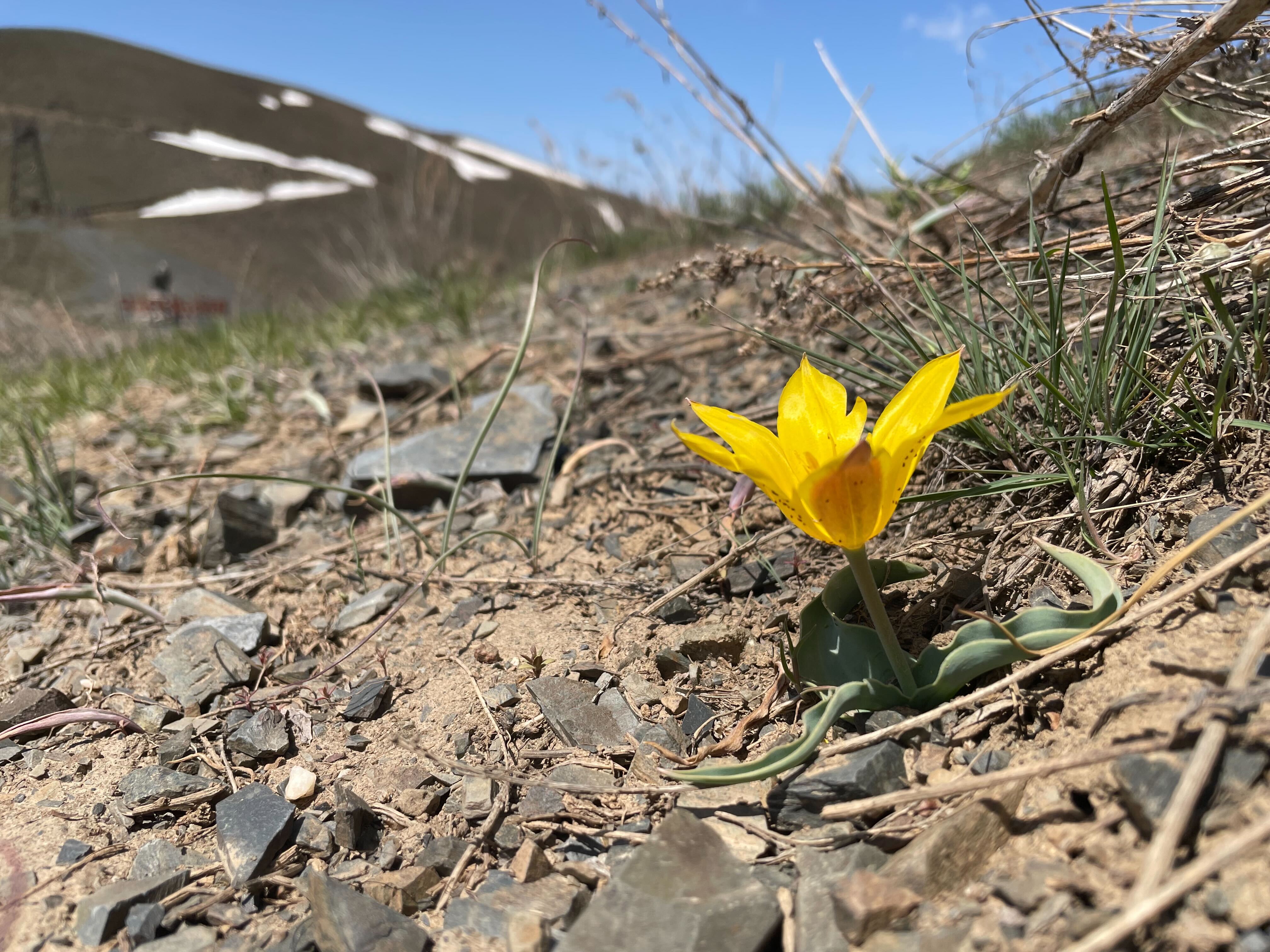
When you think of tulips, chances are you picture vibrant spring gardens or the iconic striped fields of the Netherlands. However, behind these cultivated tulips lies a wilder story — one of resilience, diversity, and survival. In remote mountains, steppe, grasslands, and semi-deserts the wild ancestors that enabled the creation of horticultural tulips reside. Understanding the conservation status of these wild tulip species is not an easy task but is crucial to their survival.
A powerful new conservation tool is shifting the way we think about species conservation, including that of wild tulips. It’s called the IUCN Green Status of Species, and it’s changing the conservation narrative from one of decline to one of recovery and restoration. In this blog we will explore what the Green Status of Species is, why it matters, and what the first assessments of wild tulips tell us about their conservation needs.
For decades, the IUCN Red List of Threatened Species has been the global gold standard for tracking extinction risk. When a species is labelled Critically Endangered, Vulnerable, or Endangered, we know it’s in trouble. This list has underpinned global conservation efforts for decades and remains an extremely valuable tool for prioritising where to focus conservation attention. However, the Red List doesn’t tell us:
- The status of a species relative to its ancestral natural range.
- What role conservation has played in its survival up to this point.
- What role conservation could play in helping the species moving forward.
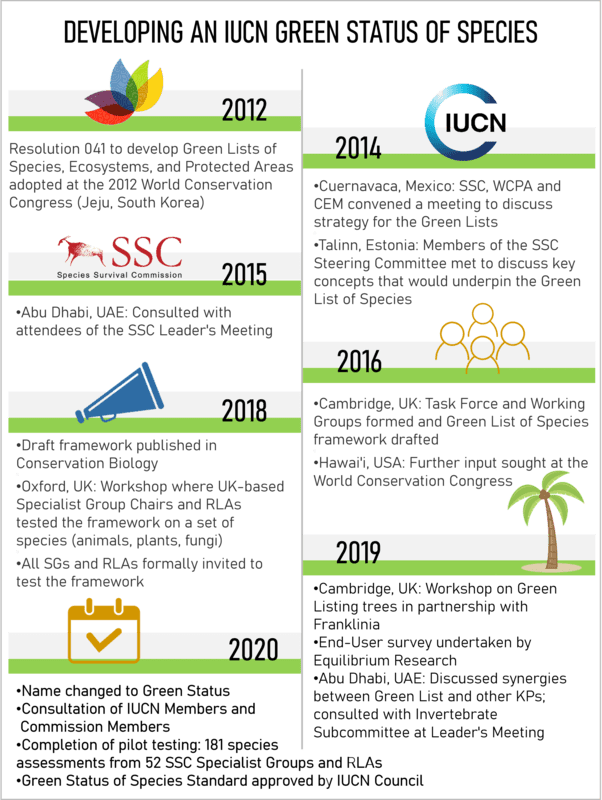
That’s where the Green Status of Species comes in. Formally launched in 2021, after Resolution 041 was adopted at the IUCN World Conservation Congress Jeju South Korea, in 2012 paved the way for its development. It is the first global framework that tracks how a species has fared based on its estimated natural range and its recovery potential.
In brief, a species receives a Species Recovery Score (from 0–100%) based on how well it is doing across its historical, indigenous range. To estimate this score a species is range is separated into relevant partitions by experts. For each of these partitions the species is assessed as to whether it is:
- Absent – It existed in the area historically but now does not exist.
- Present – It exists in the area but is declining in numbers so that it is unlikely to sustain itself.
- Viable – Its populations are stable and self-sustaining.
- Functional – It is present in sufficient density to plays its natural role in the ecosystem.
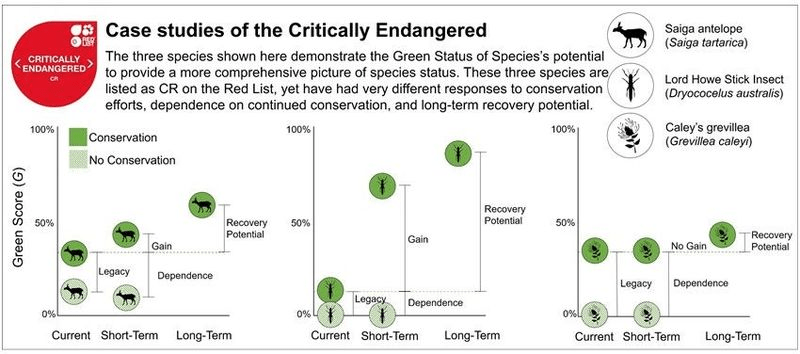
In addition to the Species Recovery Score, assessors also can calculate four other metrics:
- Conservation Legacy – How much past conservation efforts have helped protect the species.
- Conservation Dependence – How reliant the species is on ongoing conservation support.
- Conservation Gain – How much improvement is possible in the near term with conservation action.
- Recovery Potential – What recovery is possible in the long-term with sustained effective conservation action.
Together, these metrics help tell a story of progress and hope, rather than just focusing on extinction, bringing a valuable new angle to understanding the conservation needs of a species. Together the Green Status of Species and the Red List provide a crucial source of information that can help guide future efforts to protect biodiversity.
From previous work by Specialist Group members and the broader wild tulip conservation community we know that many wild tulip species are threatened with extinction. However, at the start of 2025 there were no wild tulips assessed based on the Green Status of Species process. In fact, less than ten plant species had been assessed under this new scheme. So as part of this growing movement and the need for more plant assessments to be conducted the Wild Tulip Specialist Group undertook the first ever assessments of the recovery potential of wild tulip species.
Three key wild tulip species were selected for the assessment process: Tulipa greigii, T. kaufmanniana, and T. fosteriana. These are wild tulip species at the centre of key horticultural groups of tulips, while both T. greigii and T. kaufmanniana are not considered threatened with extinction and T. fosteriana is considered Threatened but in the lowest threat category. Overall, therefore these species are of crucial horticultural value but are not necessarily considered conservation priorities under the Red List. However, we were interested to see whether the Green Status of Species process brought to light a new way of looking at their conservation needs.
The three Green Status of Species assessments can be found at the links below.
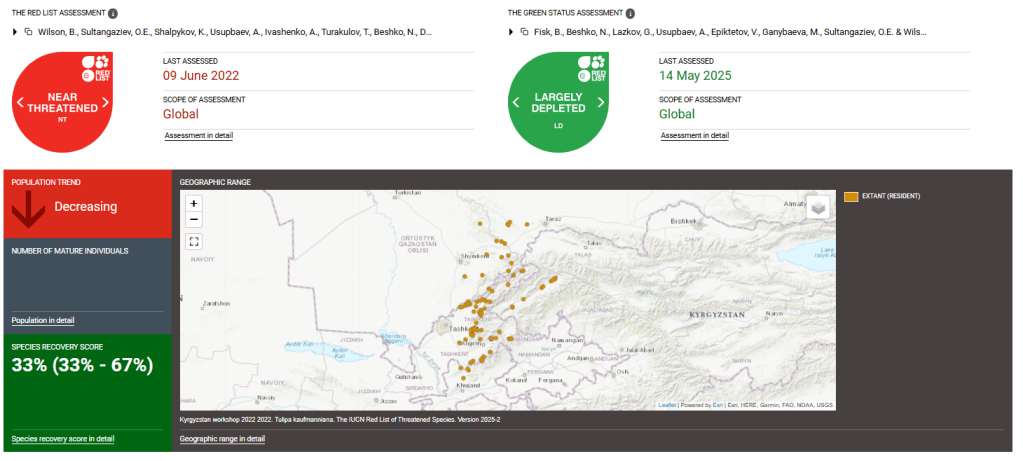
These three species are found in Central Asia and face a similar array of threats as shown in their Red List reports. However, as part of this new assessment process tulip Specialist Group members worked together to determine a baseline year for these species when they would be considered in a natural state – before human impacts began. Specialist group members then estimated the expected range of the species at this baseline year, and this was used as the ancestral range of the species to which its current distribution and population was compared. Over a number of months and several different calls the group worked together to assess how each of these species was doing across expert selected partitions of their ancestral range. Piecing together the story of how these species distribution and population had changed over time due to human impacts.
The overall results showed that all three species were Largely Depleted meaning they were well below their natural state across their ancestral distribution. It was also noted that although conservation, primarily through protection of populations in protected areas, had some conservation impact it had not significantly altered the course of these species’ declines. Overall, the Green Status of Species therefore highlighted that although these species were not necessarily close to extinction, they were continuing to decline and were far below their natural state. So, although they may not be priorities based on the Red List, they were certainly of conservation interest.
Applying the Green Status of Species to tulips has of course come with challenges. There is a myriad of data gaps for tulips with many species still under-studied; quantifying the role of tulips in ecosystems is difficult; identified ancestral areas may no longer be restorable due to agriculture or development; rising temperatures and shifting rainfall patterns due to climate change add another layer of complexity. Nonetheless we have shown that with perseverance and expert knowledge tulips can be assessed using the Green Status of Species process, and that this tool adds a crucial new perspective on tulip conservation.
In summary, applying the Green Status of Species to tulips allows us to have
- A more complete understanding of their conservation status – Information on the species natural distribution and populations complements data on its extinction risk.
- A bigger vision for restoration – The goal isn’t just to stop extinction—it’s to return species to full, thriving roles in their ecosystems.
- A clearer picture of success -We could celebrate recovery in regions where tulips are bouncing back—something the Red List alone doesn’t show.
- A tool for smarter conservation – Green Status helps highlight which species or areas have the most potential for gain, making conservation efforts more efficient.
- A way to measure dependence – Some tulips may only survive thanks to seed banks, ex situ cultivation, or ongoing habitat management. Knowing this helps secure long-term support.
Now that these assessments are complete, we must start to think about conservation action. Hopefully based on these valuable new reports we can ensure any implemented action is targeted and effective so that wild tulips can not only avoid extinction but begin to thrive in the wild.


Thank you for this article
I am a garden -horticulturist and have a long standing passion for tulipes and in particular wild tulipes. À particulier number of species that accompagniez traditional peasant agriculture in the South of France will benefit by this reframing of conservation status to conservation potential.
These are referred to as messicole species and include for example Tulipa raddii, Tulipa sylvestris and Tulipa agenensis
Some of my recent work has proposed including these species in cover crop mixes that include traditional wheat varieties, or in the context of an orchard, other messicole plants. In this sense, with the growing concern to return to traditional practices in agriculture, the potential for rehabilitation of the species noted above and which are considered on the red list, when considered on the green list, reframe them as potentially resilient.
best regards
Mireille
LikeLiked by 1 person